
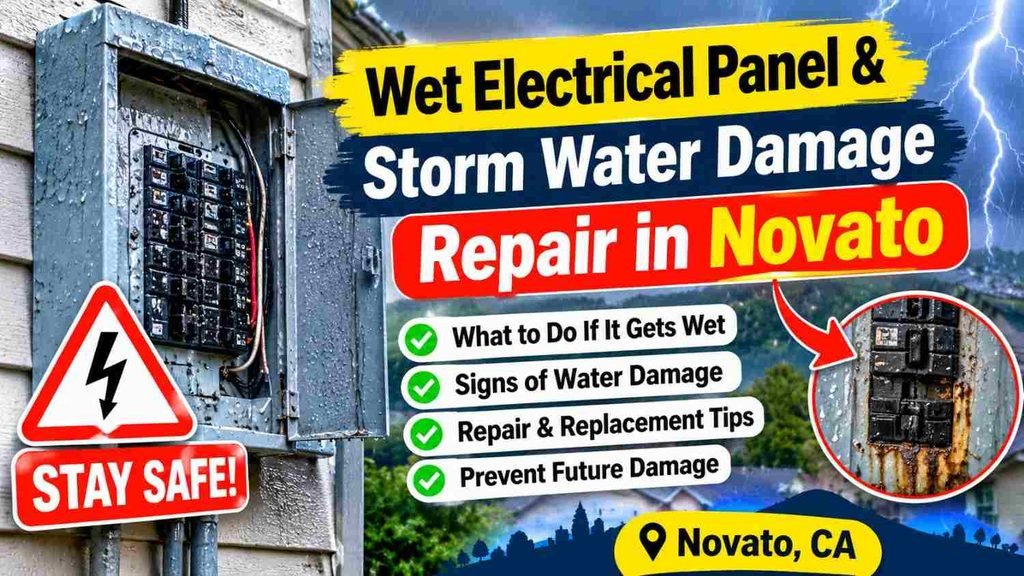
Novato storm safety guide
Water got into your panel? Stay calm, stay away, and read the steps below.
Get Emergency Electrical HelpIf your electrical panel gets wet, do not touch it, do not stand in water near it, and do not flip any breaker. Keep everyone away, and call an electrician and your utility. A wet panel can shock you or start a fire. That is why wet electrical panel and storm water damage repair in Novato should always be done by a licensed professional.
Novato gets heavy winter storms. Rain can come in through a roof leak, a bad meter seal, or a flooded garage. This guide explains what to do first, what damage looks like, and when a panel must be replaced. It is for information only. It does not replace a visit from a licensed electrician.
What to Do If an Electrical Panel Gets Wet in Novato
Your first job is to stay safe. Water and electricity are a dangerous mix. The Electrical Safety Foundation International (ESFI) says electrical hazards can linger after flood water goes down.
- Stay out of the water. If the floor is wet near the panel, do not walk in. Water can carry current.
- Do not touch the panel. Do not open it, wipe it, or flip breakers.
- Cut power only if it is 100% safe. If the main switch is in a dry spot, you can turn it off. If you must step in water to reach it, do not.
- Call your utility. They can shut off power at the meter. In Novato, that is usually PG&E, but check your bill to confirm.
- Call an electrician. Tell them the panel is wet and describe any smells, sounds, or sparks.
- Call 911 if you see fire, smoke, or sparking.
Never do this
Do not use a hair dryer, space heater, or towel on a wet panel. Do not turn power back on to “test” it.
Do this instead
Take photos from a safe distance. They help with insurance and help your electrician plan.
If the power is already out, read our guide on Novato power outages. If you use a generator, follow these generator safety rules in Novato. A generator hooked up wrongly to a wet panel is very dangerous.
Can a Wet Electrical Panel Cause a Fire?
Yes, it can. Water can create a path for current where none should exist. That can cause short circuits, arcing, and heat. The Federal Alliance for Safe Homes (FLASH) notes that fires from shorted circuits in flooded electrical systems are a serious problem.
Why the risk can stay hidden
A panel may look dry after a day or two. Inside, though, moisture can sit around bus bars and breaker contacts. Dirt and minerals in the water can leave a film that conducts power. Fire can start days later, not just during the storm.
Already smelling something odd? See our page on a burning smell from an outlet or panel. It is a sign to act right away.
Signs of Water Damage in an Electrical Panel
Some signs are easy to see. Others only show up when a pro opens the panel. Look from a safe distance. Never open the cover yourself.
| Sign | What it may mean |
|---|---|
| Water drips or stains on or near the panel | Water entered from the roof, wall, or conduit |
| Rust or green/white crust on the cover or inside | Corrosion from moisture. It can weaken contacts |
| Buzzing, crackling, or sizzling | Arcing or a short. Treat as an emergency |
| Burning or musty smell | Overheating or long-term moisture |
| Breakers trip again and again | Moisture causing faults. See why a circuit breaker trips |
| Warm or discolored breakers | Heat from poor contact or shorting |
| Flickering lights | Loose or corroded connections. See flickering and dimming lights |
Is a Water-Damaged Electrical Panel Safe to Use?
No. Do not use it until a licensed electrician inspects it. FLASH says an electrical system hit by flood water should not be turned on until a licensed electrician checks it. These systems do not simply “dry out” and go back to normal.
This also applies if the panel only got rain from a leak. A small leak can still damage the parts inside. Treat any wet panel as unsafe until a professional says otherwise.
Can Rainwater Damage Circuit Breakers?
Yes. Rain can damage breakers, even without a flood. Here is how:
- Corrosion: Moisture rusts metal parts and weakens the connection.
- Failed trip function: A breaker may not trip when it should. That is a fire risk.
- Nuisance tripping: Damp breakers may trip with no real overload.
- Loose